 +1-214-981-1707

Blog
Biggest Swords in Video Games That US Gamers Love

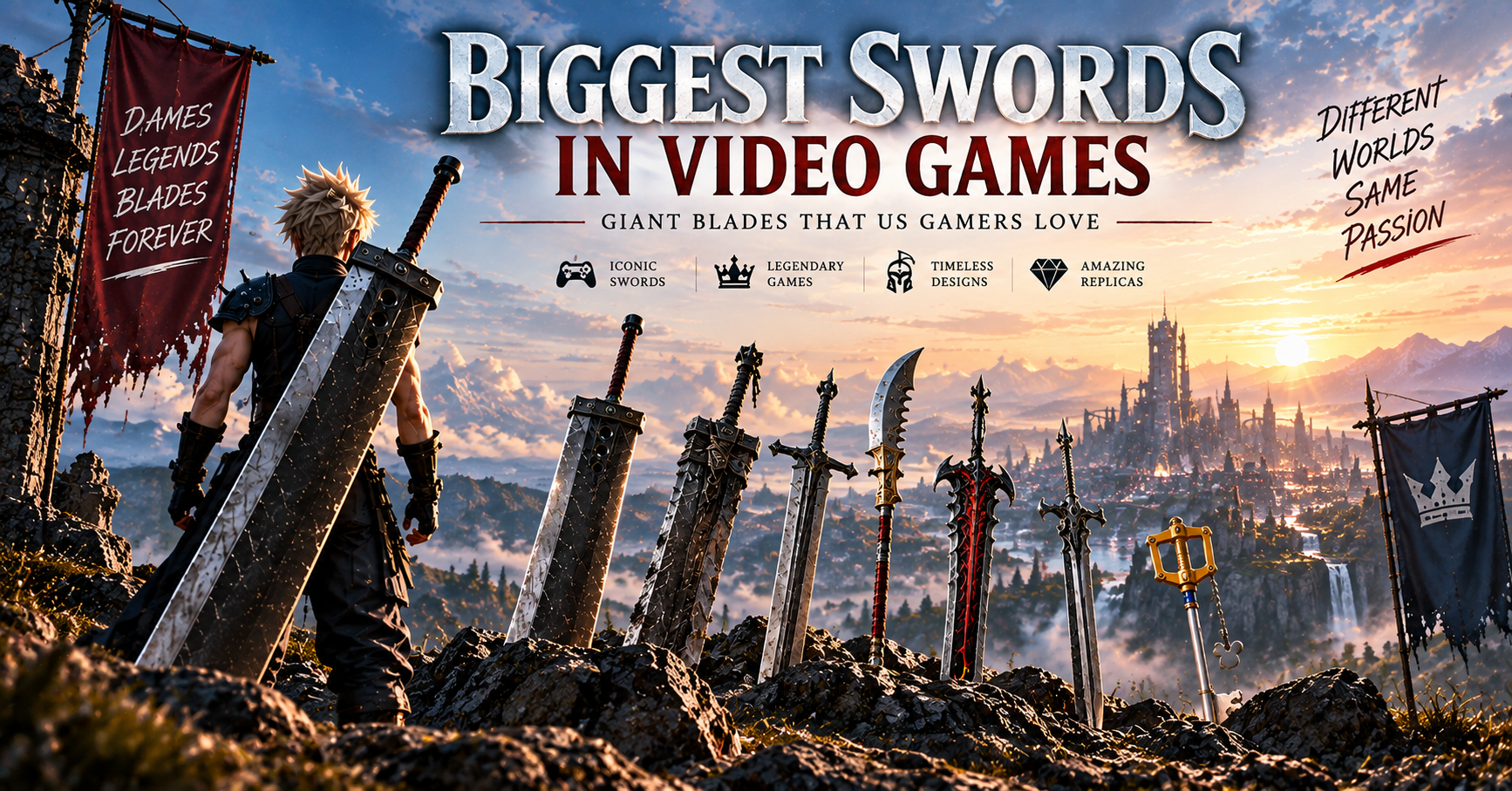
A “giant” sword, in this context, stands as tall as its character or taller, wide enough to double as a shield, and far too massive for any real person to lift or swing. This scale isn’t accidental. Designers use size as visual shorthand, letting players instantly read a character’s strength and personality before a single stat or line of dialogue is revealed.
That same jaw-dropping, instant-read quality is exactly why these designs crossed over into the collector world, becoming some of the most sought-after replica pieces around. Here’s our countdown of gaming’s biggest blades, where each one comes from, and what to check before buying an oversized sword of your own.
Why Are Giant Swords So Popular in Video Games?
Size communicates power faster than any stat sheet or line of dialogue; a silhouette reads in a fraction of a second, letting players recognize a character purely by the outline of their blade. Oversized designs signal slow, heavy, crushing strikes, while slim ones promise speed and precision, all communicated without a single word of text.
Games aren’t bound by real-world physics, so a design too massive for any human to lift doesn’t break immersion; it defines the fantasy instead. That same bold, instantly readable visual impact that works on screen translates just as well off it, which is exactly why these striking shapes became so popular as displayable gigantic swords replicas among collectors today.
Biggest Swords in Video Games
This countdown mixes true video game blades with manga and anime crossover designs fans consistently group alongside them, since the line between the two often blurs. Each entry calls out exactly where its blade originates, so you know precisely what you’re looking at before diving in.
1. The Buster Sword — Final Fantasy VII
Arguably the most recognizable giant sword in gaming, largely thanks to Final Fantasy VII’s massive cultural reach since its 1997 release. Roughly as tall as Cloud himself, it’s a single thick slab of steel no fuller, minimal taper, blunt rather than elegant. That simplicity is exactly why it endures: reduced to a gray rectangle, it stays instantly recognizable even at low detail or thumbnail size. Decades later, it remains one of the most searched and reproduced designs around, with demand spanning the original FFVII shape through Advent Children variants like the Masamune Sephiroth Sword.
2. The Dragon Slayer — Berserk / Guts
Is the Dragon Slayer Sword from a video game? No, the Dragon Slayer sword actually originates from Kentaro Miura’s manga Berserk, first published in 1989, not from a video game. However, gamers consistently rank it alongside the biggest swords in gaming, and it earns that spot.
Standing roughly 6 to 7 feet tall, the Dragon Slayer is designed to look deliberately crude, thick, heavy, and unpolished, more like a raw slab of iron than a finely crafted blade. This rough, brutal design reflects Guts himself: a warrior who survives through raw strength and willpower, not technique or elegance.
The sword has appeared in actual games, including Sword of the Berserk: Guts’ Rage and Berserk and the Band of the Hawk, bringing it firmly into gaming culture. Its influence runs even deeper director Hidetaka Miyazaki has openly credited Berserk as a major inspiration behind the dark, weighty combat feel of Dark Souls and Elden Ring.
3. The Zweihander and Greatswords — Dark Souls
Is the Zweihander a real sword? Yes, it was a genuine historical design used by European soldiers, roughly 5 to 6 feet long and 5 to 8 pounds, built for sweeping strikes rather than close-combat finesse.
Dark Souls exaggerates both the scale and weight well beyond historical accuracy for dramatic effect. That added size shapes gameplay directly, swings are slow and drain stamina fast, rewarding players who commit to heavy, deliberate hits over quick repeated strikes.
Other oversized Souls blades, like the Greatsword of Artorias, follow the same “big, slow, devastating” philosophy. What sets this franchise apart is its grounding: rather than inventing an impossible shape, it starts with real history and exaggerates it, giving these blades a weight others don’t have.
4. The Bisento — One Piece / Whitebeard
Is the Bisento from a video game? No — it originates from the manga/anime One Piece, not a video game, though it has carried over into titles like the Pirate Warriors series and countless merchandise lines.
Officially measuring around 22 feet (666 cm), this isn’t a standard sword shape at all it’s a polearm, with a long shaft and a heavy curved blade at the end, giving it far more reach than a typical vertical blade silhouette.
Properly named Murakumogiri, it ranks among the Twelve Supreme Grade blades in the series, reserved for the setting’s most powerful wielders.
For collectors, its appeal is distinct the diagonal polearm shape breaks up a wall display differently than a straight, vertical slab blade, adding visual variety alongside pieces like the Buster Fusion Sword.
6. Devil May Cry — Dante’s Rebellion
Is Astaroth’s Kulutues a sword? Not quite. Although it’s often mislabeled online as an axe-sword hybrid, Kulutues is officially classified as a giant axe in the game, not a sword. In Soulcalibur VI, Astaroth stands around 7’2″ (220 cm), and Kulutues matches that scale with a blunt head, long haft, and weight concentrated at the top a shape that visually telegraphs slow, crushing power rather than a bladed strike.
For an actual giant sword pick from this franchise, look to Nightmare’s Soul Edge instead. Unlike a clean, geometric design, Soul Edge is malformed and organic-looking, twisted with jagged, uneven edges and an unsettling eye embedded directly in the blade, a design built to feel cursed rather than crafted, and one of the most distinctive giant blades in the genre.
7. Kingdom Hearts — Sora’s Kingdom Key
Is the Kingdom Key actually a giant sword? Not by size; it’s the outlier on this list. Roughly the length of a standard one-handed sword, it doesn’t rely on scale to stand out. If you want Sora’s iconic blade, our all-metal Kingdom Key replica measures 34 inches.
Instead, it earns its place through silhouette. A silver shaft, gold guard, tooth-like detailing along the blade, and a keychain pommel token nothing in real sword history looks remotely like it. It’s instantly recognizable not because it’s big, but because nothing else looks like a giant key shaped into a blade.
Worth noting: later Keyblade designs in the series grow larger and far stranger, so don’t assume size; check dimensions per design rather than treating the Kingdom Key as representative of the whole lineup.
Explore the full range in our Kingdom Hearts Keyblades collection.
What is the biggest sword in video games?
There’s no official ranking, because most games never publish exact blade measurements. Sizes are estimated from character-height comparisons, official artbooks, or fan measurements taken from in-game models, which is why the “biggest” answer depends on who you ask.
That said, a few names come up consistently, each for a different reason:
- The Dragon Slayer (Berserk / Guts) is often cited for sheer mass, a thick, crude slab of iron built to look heavier than anything else on this list.
- Dark Souls’ ultra greatswords get named for realistic scale pushed to its limit grounded in historical Zweihander proportions, then exaggerated further.
- The Buster Sword (Final Fantasy VII) wins on cultural recognition not necessarily the tallest blade, but the one most gamers picture first when “giant sword” comes up.
What to Look for in a Giant Sword Replica?
Buying a giant replica isn’t like ordering a regular display piece size changes everything, from shipping to mounting. A few extra feet can mean the difference between a showstopping display and one that’s awkward to hang or too big for the room. Here’s what actually matters before you buy.
1. Check Exact Dimensions, Not the Product Photo
Product photos are easy to misjudge there’s no scale reference in frame, the model’s height usually isn’t stated, and staged backgrounds can hide a piece’s true size entirely. A sword can look modest in a photo and turn out to be over five feet long once it arrives.
Four numbers matter before you buy:
- Sword length — includes the handle
- Blade length — blade only, handle excluded
- Blade width
- Handle length
Mixing up overall length and blade length is the most common ordering mistake, so always confirm which number you’re looking at.
Before ordering, measure your own space too: wall height for mounting, ceiling clearance if it’ll stand upright, and doorway width to make sure it can actually be carried inside.
2. Are Giant Video Game Sword Replicas Life-Size?
Not always. Some replicas are scaled close to their in-game proportions, while others are intentionally scaled down for safer shipping and a better fit in a normal-sized room.
There’s no fixed standard here; there’s no industry definition of “life-size” for a fictional design, and many source designs were never given official measurements to match in the first place.
The only reliable check is the listed dimensions on the individual product page; never assume based on the character or the game it’s from.
3. Materials: Steel, Foam, and Resin
- Steel (stainless/carbon): Rigid, detailed, and the standard choice for display pieces. Keep in mind weight adds up fast on a longer blade.
- Foam/EVA: Lightweight and built for conventions and photos, but carries less presence as a static display piece.
- Resin/composites: A middle ground strong on fine detail, but more brittle across a long span.
4. Weight, Stands, and Wall Mounting
Weight matters more than length on oversized pieces; a long blade concentrates its load wherever it’s supported, so a few extra pounds at the tip makes a real difference.
Floor stands: Need a stable base with a real footprint. Corner placement is often more secure than an open wall. When checking ceiling clearance, remember to add the stand’s height, not just the blade’s.
Wall mounting: Anchor into studs, never drywall alone. Use hardware rated above the piece’s total weight, and use two mounting points to spread the load evenly. Hanging anything this size is safer with two people.
Browse our display stands collection for mounting options built for oversized pieces.
5. Cosplay vs. Display
Display and cosplay pull in different directions. A display piece favors presence, and detail steel works fine here since it stays mounted and never has to be carried. Cosplay favors lightweight and portability, which is where foam and EVA builds take over.
This split is also why LARP-style swords exist as their own category built specifically for handling, not just standing still.
Before committing to a material, check your event or convention’s prop rules. Many conventions set their own limits on rigid materials, blade length, or weight for anything carried on the floor.
Final Thoughts
Giant swords endure for one simple reason: exaggerated size gives instant visual identity, and that’s the whole appeal, not a design flaw to explain away. A character’s strength reads the moment their blade appears on screen, no stats or dialogue required.
That logic doesn’t depend on any single franchise staying popular. It’s why the same “bigger equals stronger” visual language has held up across decades of console generations, from 16-bit sprites to modern 4K detail.
It’s also exactly why these blades made the leap into real collections. The same bold, simple outlines that read instantly on a screen read just as clearly mounted on a wall, which is what makes them such striking display pieces in the first place.
Ready to bring one home? Explore our full Video Game Swords collection and always double-check the listed dimensions on each product page before you buy.