 +1 2149 811 707

Blog
Complete Rambo Knife History – Jimmy Lile to Modern USA

When John Rambo emerged from the wilderness in 1982’s First Blood, he carried more than just a knife. He held a symbol of American resilience, survival, and the unbreakable spirit of a Vietnam War veteran. That iconic survival blade transcended its role as a movie prop and became an emblem of American action cinema. For over 40 years, the Rambo knife has represented American craftsmanship and the determination that built this nation.
Created by Arkansas master knifemaker Jimmy Lile and designed for one of Hollywood’s greatest action heroes, it’s been replicated worldwide. From a small Russellville workshop to becoming one of the world’s most recognized Rambo knives, this is the complete story of an American legend.
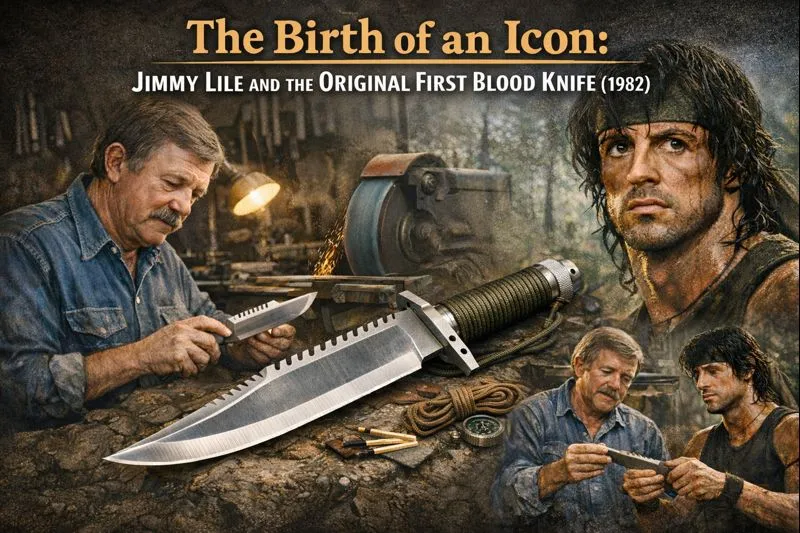
The Birth of an Icon: Jimmy Lile and the Original First Blood Knife (1982)
1. Introduction to Jimmy Lile:
While preparing for First Blood (1982), Sylvester Stallone searched for a real survival knife rather than a simple movie prop. His search led him to Jimmy Lile, a respected master knifemaker known for practical, durable designs. Lile’s craftsmanship made him the perfect choice for creating an authentic blade.
2. The Stallone Connection with Jimmy Lile:
Stallone was immediately impressed by Jimmy Lile’s knives and insisted on direct collaboration. The two worked closely through detailed design meetings, discussing functionality, balance, and realism. Stallone wanted a knife that could truly be used in survival situations, leading Lile to build and refine multiple prototypes.
3. The Original First Blood Knife Design:
The final First Blood knife was designed as a true survival tool, not a decorative accessory. Built for strength and reliability, it reflected Stallone’s demand for authenticity and Lile’s expert craftsmanship. The knife’s rugged design helped turn it into one of cinema’s most recognizable and influential blades.
4. Cultural Impact:
The knife became as famous as the movie character. After 1982, fans rushed to buy it. It started the survival knife boom of the 1980s, influenced tactical knife designs for many years, created a replica knife market, and inspired many imitations and tributes.
Evolution of The Mission Series: Rambo First Blood Part II (1985):
The Evolution of the Mission Series in Rambo: First Blood Part II shows how the knife design changed to match a stronger story, bigger action, and Rambo’s growth as a hardened soldier.
Why a New Design Was Needed:
A new knife was needed for the sequel because Rambo was no longer a drifter but a trained soldier. The jungle setting required a larger, tougher blade. Stallone wanted a bold design and trusted Jimmy Lile to create a powerful, practical knife.
Design Changes and Improvements:
The knife featured major upgrades, including a larger size, stronger build, improved survival features, and a more aggressive, military-focused design.
1. Size Increase:
The knife was made bigger and heavier than the original. It had a longer blade and overall length, giving it a stronger, more powerful feel suited for combat and survival use.
2. Technical Modifications:
The design added center-slotted saw teeth, sharper serrations, a better hollow handle, and a larger survival kit. It also included a diamond sharpening stone and a premium buffalo leather sheath.
3. The Mission Series Designation:
Jimmy Lile named this design the Mission Series. It was meant as a complete military survival system, built for serious outdoorsmen and soldiers, and became Lile’s most popular
Why This Became the Most Popular Design:
This design had the perfect mix of size and usefulness. It looked more tactical than Part I, had better survival features, worked well in real wilderness, appeared in the most successful Rambo film, and became the most copied and collected version.
Influence on the Tactical Knife Industry:
The knife changed the industry by starting the black tactical knife trend. Hollow-handle survival knives became common, multi-tool features were added to combat knives, and many makers copied the style, creating the famous “Rambo-style” knife category.
The Designer Transition: Gil Hibben Enters the Story:
For Rambo III, Stallone wanted a bold, exotic knife. Jimmy Lile declined, so Gil Hibben, a master of fantasy blades, was chosen, starting a new chapter in the Rambo knife legacy.
Why the Change from Lile to Hibben:
For Rambo III, the knife design changed direction. Stallone wanted something bold and exotic. Jimmy Lile declined due to cost, and both parted with mutual respect. A fantasy-style designer was needed.
Who is Gil Hibben?
Gil Hibben, born in Wyoming in 1935, began making knives in the 1950s. He later moved to Kentucky, founded Gil Hibben Knives, and became famous for custom and fantasy blade designs.
Hibben’s Reputation:
Hibben was known for exotic knives, perfect balance, and throwing blades. He helped create the fantasy knife genre, was respected by the American Bladesmith Society, authored books, and entered the Knifemakers Hall of Fame.
The Stallone Connection:
Stallone already owned Hibben knives and admired his artistic style. Hibben’s designs fit Rambo III’s exotic setting perfectly, starting a long collaboration built on shared respect for craftsmanship.
A Fantasy Knife is Born: Rambo III (1988):
In Rambo III (1988), Gil Hibben designed a bold fantasy knife with dramatic style and practical features, perfectly suited for Rambo’s epic jungle missions and larger-than-life action scenes.
Stallone’s Vision for an Exotic Design:
Set in Afghanistan, Stallone wanted a knife reflecting Asian and Middle Eastern influence, visually striking on screen. It moved from a survival tool to a combat weapon, symbolizing Rambo’s evolution as a warrior and artistic expression through the blade.
The Design Process:
Gil Hibben created multiple prototypes, experimenting with shapes and features. Stallone was hands-on, even testing the “lost” Rescue Mission knife briefly seen in the film. The final design balanced drama, functionality, and cinematic impact.
Unique Design Features:
The knife included a blood sight slot, serrated curves honoring Rambo’s unit, Bowie-style clip point, double-edged tip, laminated hardwood handle, and brass guard and pommel.
Why This Became the Most Collected:
It’s the most dramatic Rambo knife, appealing to collectors. Limited handmade editions, iconic movie scenes, premium materials, and peak craftsmanship make it highly photogenic and valuable, representing Rambo’s warrior peak.
The Later Films: Rambo (2008) and Last Blood (2019)
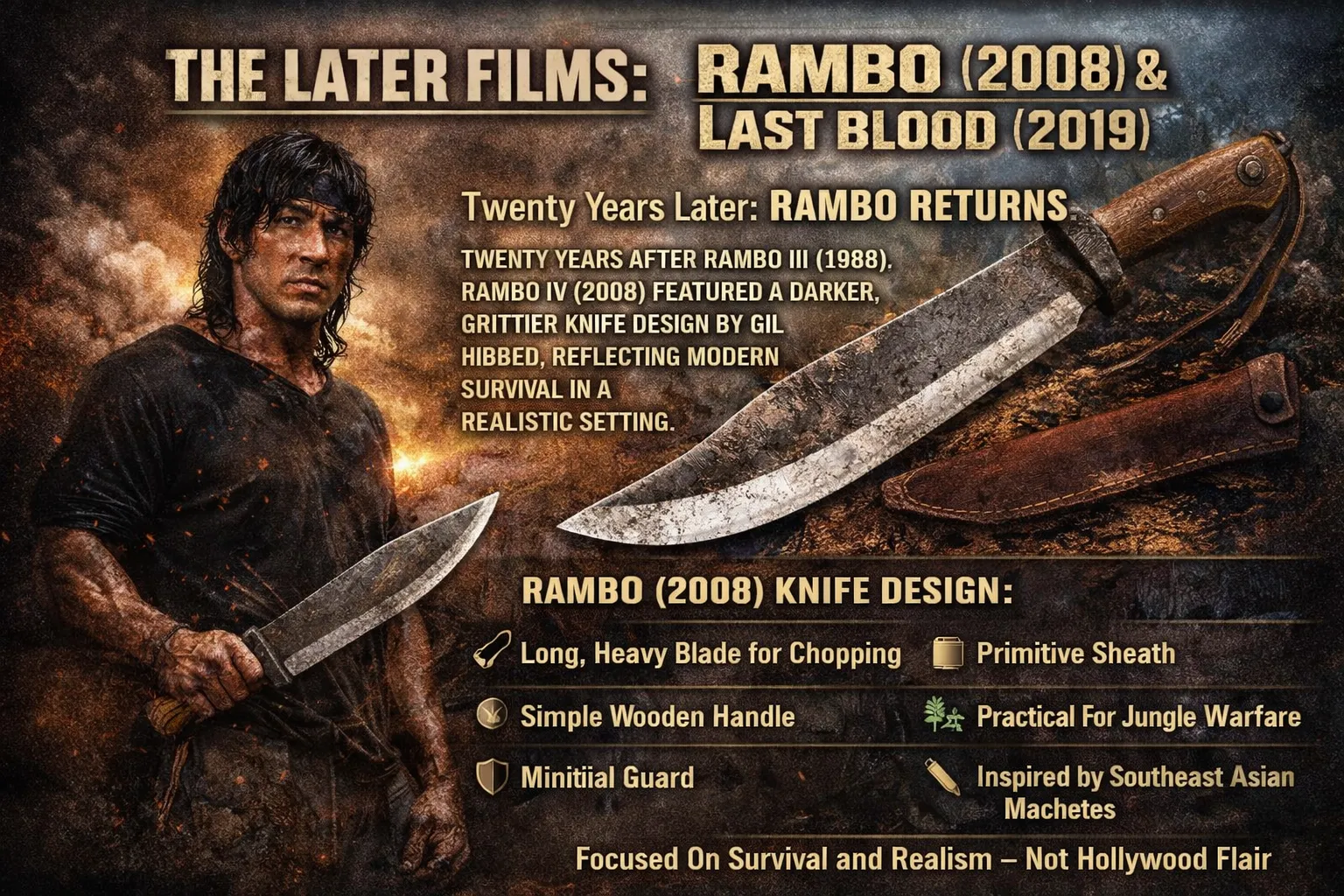
Twenty Years Later: Rambo Returns:
Twenty years after Rambo III (1988), the action movie world had evolved. For Rambo IV (2008), Gil Hibben returned to design a new knife that matched the film’s darker, grittier tone. The design embraced a modern, practical approach, reflecting both Rambo’s survival skills and the harsher, more realistic setting.
Rambo (2008) Knife Design:
The knife had a crude, hand-forged, jungle-made look with a machete-style blade, reflecting the film’s brutal tone. It was less refined than earlier designs, emphasizing function over style.
Features:
Long, heavy blade for chopping, simple wooden handle, minimal guard, primitive sheath, practical for jungle warfare, and inspired by Southeast Asian machetes—focused on survival and realism rather than Hollywood flair.
Last Blood (2019): The Heartstopper
In the franchise’s final chapter, the Heartstopper was a modern tactical knife. It marked a departure from classic Rambo designs, reflecting contemporary knife trends and emphasizing advanced materials, combat functionality, and 21st-century tactical style.
Pohl Force Collaboration:
Pohl Force, a German-American tactical knife company known for military and law enforcement designs, brought modern tactical features to the Heartstopper. Their use of premium materials and advanced engineering gave the knife a realistic, professional, combat-ready feel.
Heartstopper Features:
The Heartstopper featured a tanto-style blade with a black tactical finish, an ergonomic modern handle, and a Kydex sheath system. It focused on 21st-century tactical performance, using modern knife technology rather than classic survival features.
How Modern Designs Reflect Trends:
Modern knife designs reflect a shift from 1980s survival-focused tools to 2000s tactical weapons. Instead of emphasizing wilderness survival, modern knives prioritize combat efficiency, ergonomics, and speed. Influenced by military and combat knife designs, they commonly use materials like G10 handles and Kydex sheaths. This evolution mirrors post-9/11 tactical culture, where functionality aligns with modern warfare and security demands.
The Replica Industry: From Movie Props to Collector’s Items
Rambo knives sparked a booming replica industry, evolving from movie props to highly sought collector’s items prized for authenticity and craftsmanship.
Birth of the Movie Replica Knife Market:
The release of First Blood in 1982 sparked the birth of the movie replica knife market. Demand for Rambo knives exploded, leading manufacturers to produce licensed and unlicensed versions. This trend influenced other movie props and boosted the American knife industry, creating a lasting economic and cultural impact.
Licensed vs Unlicensed Reproductions:
Licensed reproductions were officially approved, ensuring authenticity and quality, while unlicensed versions copied the design without permission, often sacrificing craftsmanship for profit.
The Licensed Replicas:
These replicas of Rambo knives were officially authorized by Lionsgate, meeting strict quality standards and often including certificates of authenticity and serial numbers. Sold at premium prices, like in the United Cutlery Masterpiece Collection, these knives were sanctioned by the original designers and legally marketed as authentic, collectible reproductions.
Unlicensed Versions:
Unlicensed versions were generic survival knives that copied the Rambo style without official approval. They had no connection to the films, varied widely in quality, sold at lower prices, and could not use Rambo branding. Often less accurate than the originals, they existed in a legal grey area.
Quality Tiers Explained:
Rambo replicas range from budget display knives to premium, hand-finished collector editions and limited signature runs with high authenticity and value.
Budget Replicas ($40–$80): Basic stainless steel, machine-made, display-only, minimal accessories, generic packaging; ideal for casual fans.
Mid-Range Replicas ($80–$150): Better steel (440C, 420HC), accurate dimensions, functional blades, survival kits, improved sheaths; suitable for light outdoor use.
Premium Editions ($150–$300+): High-quality materials, hand-finished, serial numbered, certificate of authenticity, exact movie specs; collector-grade and investment-worthy.
Signature Editions: Engraved signatures, limited runs, commemorative packaging, enhanced display value, highly collectible.
Jimmy Lile’s Enduring Legacy:
Jimmy Lile’s skill, innovation, and mentorship shaped American knife-making, inspiring generations of craftsmen, collectors, and enthusiasts worldwide.
The Peak and the Loss:
In the early 1990s, Jimmy Lile was at the height of his career, gaining international recognition and crafting knives for presidents, celebrities, and the US military. He also taught and mentored young knifemakers. His tragic death in 1991 at age 57 was deeply felt throughout the American knife community.
Preserving the Lile Name:
After Jimmy Lile’s passing, Marilyn Lile worked to preserve his legacy, protecting his designs and intellectual property. In 2013, John Hill acquired the Lile trademark and partnered with Vaughn Neeley, forming Lile Knives LLC to produce classic Lile designs while maintaining the high-quality standards Jimmy established.
The Book: “James B. Lile, The Arkansas Knifesmith”:
Written by Bernard Levine, this comprehensive biography details Jimmy Lile’s life and work, featuring rare knife photographs, personal stories, and anecdotes. It serves as an essential reference guide for collectors and enthusiasts to verify authenticity and appreciate Lile’s craftsmanship.
Influence on Modern Knifemakers:
Jimmy Lile’s students and protégés continue his techniques, with his design elements still widely used. Hollow-handle survival knives remain popular, integrated tools are common, and his impact helped shape the American custom knife movement.
Why Rambo Knives Changed Survival Knife Design Forever
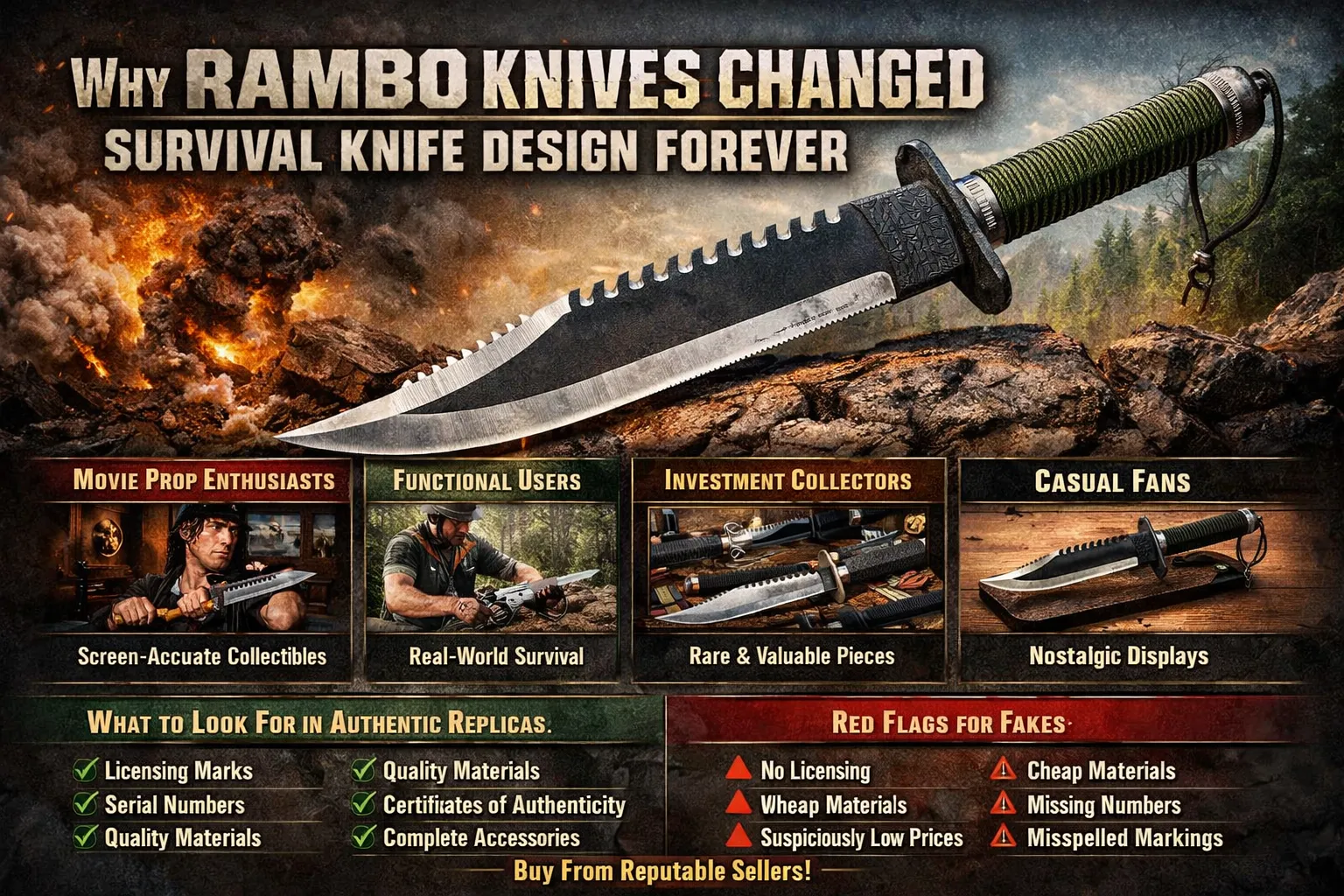
The Rambo knives sparked the 1980s “survival knife boom,” inspiring modern knives with similar features. Their cultural impact went beyond collectibles, influencing military and tactical knife designs and shaping how knives were made, marketed, and perceived worldwide.
Types of Collectors:
Movie Prop Enthusiasts:
These collectors focus on screen-accurate knives, seek limited editions and premium display pieces, research film history, and enjoy connecting with other movie memorabilia enthusiasts.
Functional Users:
These collectors are outdoorsmen, survivalists, and bushcraft enthusiasts who use knives for camping, hunting, and prepping, testing their functionality, durability, and practical performance in real-world situations.
Investment Collectors:
These collectors seek knives with long-term value, focusing on limited editions, numbered pieces, and originals by makers like Lile or Hibben. Condition, provenance, and rarity are critical for appreciation potential.
Casual Fans:
Casual fans collect one or two knives for display, gifts, or nostalgia, prioritizing appearance and sentimental value over functionality or screen accuracy.
What to Look For in Authentic Replicas:
Check for official licensing marks, serial numbers, certificates, and designer signatures or stamps. Verify quality materials, accurate dimensions and weight, complete accessories, original packaging, proper markings, solid construction, and purchase from reputable sellers.
Red Flags for Fakes:
Watch out for knives with no licensing, suspiciously low prices, poor materials, incorrect dimensions, missing serial numbers or certificates, misspelled markings, wrong blade shapes, cheap handles, or sellers lacking reputation.
Do Rambo Knives Impact American Culture?
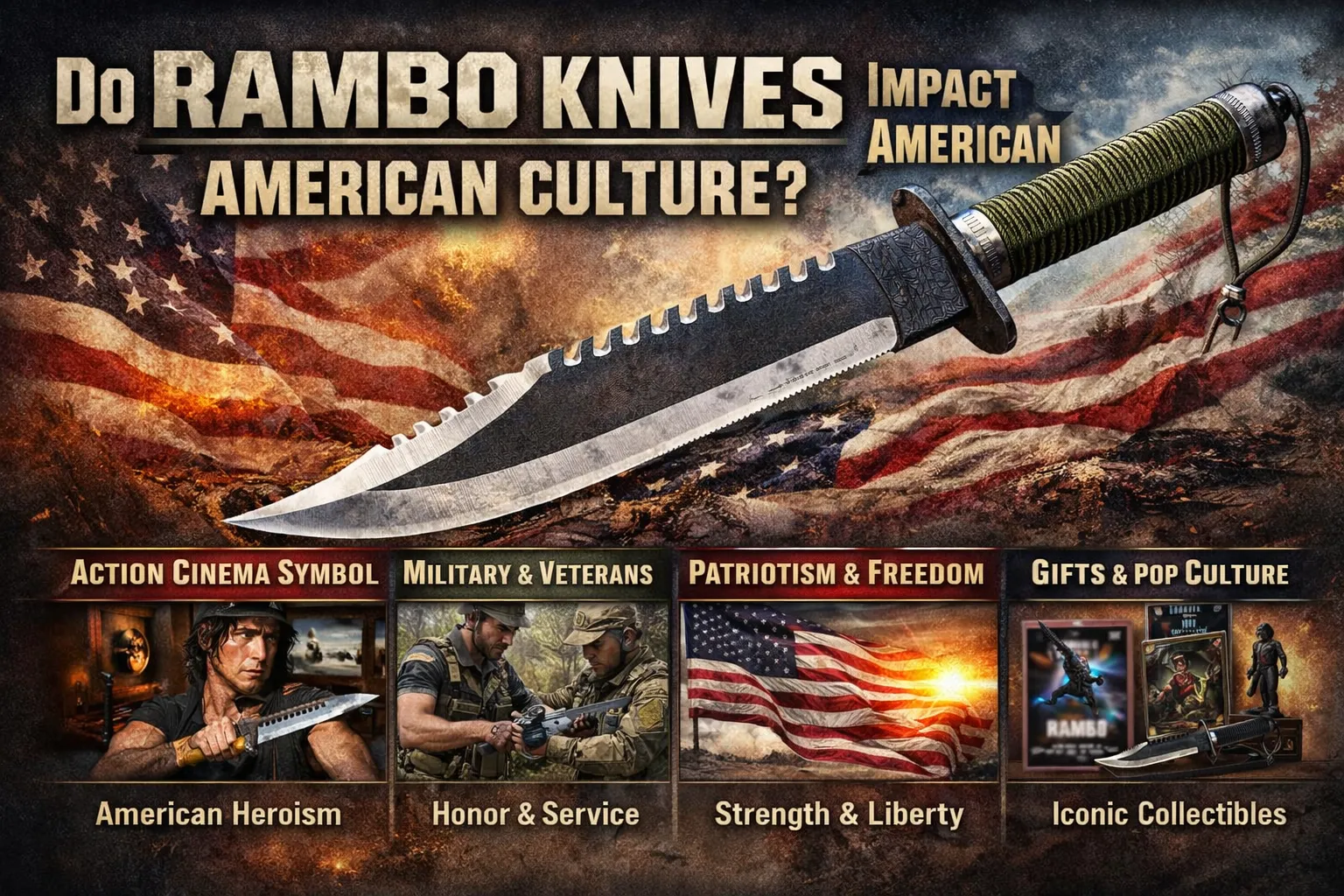
Rambo knives symbolize American action cinema and heroism, connect with military veterans, represent patriotism and freedom, serve as popular gifts, and appear frequently in pop culture, cementing their status as iconic cultural artifacts.
Where to Buy Replica Rambo Knives?
SwordsKingdom is a popular online retailer offering replica Rambo knives inspired by the iconic movie designs. Their collection includes models based on First Blood and later films, featuring classic survival-style aesthetics. These replicas are commonly purchased for display, collecting, or costume purposes rather than professional or tactical use.
Critical Legal Disclaimer:
IMPORTANT: This information is provided for educational purposes only and should not be considered legal advice.
Knife laws vary significantly by state, county, and municipality, and they change frequently. The information presented here reflects general trends but may not account for all local ordinances or recent changes in your specific jurisdiction.
Conclusion:
From Jimmy Lile’s original First Blood knife in 1982 to the modern Heartstopper, Rambo knives have shaped both knife-making and popular culture. They inspired the survival knife boom, influenced tactical and military designs, and created a global collector market. Beyond Hollywood, these knives symbolize American resilience, craftsmanship, and heroism, leaving an enduring legacy that blends practicality, artistry, and cultural significance. Through licensed replicas, educational biographies, and continued homage by modern knifemakers, the Rambo knife remains an iconic emblem of action cinema, innovation, and the timeless appeal of a well-crafted survival tool.